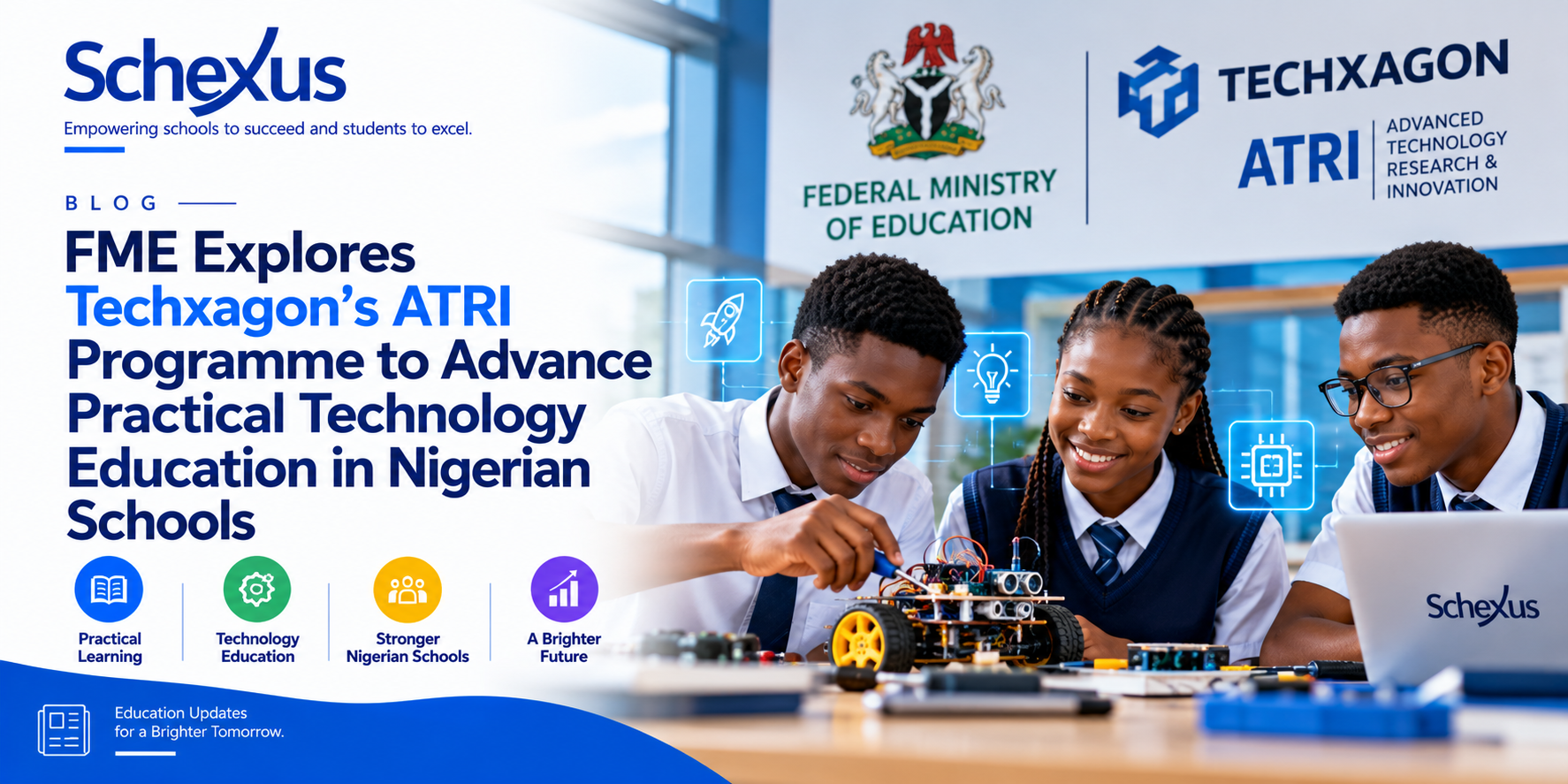
The Federal Ministry of Education has expressed interest in exploring innovative approaches to strengthening practical technology education in Nigerian schools following a presentation by Techxagon Academy on its proposed Applied Technology, Robotics and Innovation (ATRI) Programme.
In a press release published on the Ministry's official X account on September 28, 2026, the Ministry highlighted the importance of equipping learners with practical technological skills while strengthening teachers' capacity to deliver technology-focused education.
The proposed programme seeks to introduce students to emerging technologies, including coding, robotics, artificial intelligence, electronics, automation and drone technology.
What Is the ATRI Programme?
The Applied Technology, Robotics and Innovation (ATRI) Programme is a proposed initiative by Techxagon Academy designed to provide students with hands-on learning experiences in modern technology disciplines.
Presenting the programme, Techxagon Academy's Chief Operating Officer, Mr. Jude Akonam, explained that ATRI would focus on practical technology education alongside teacher training.
The proposed areas of learning include:
Coding and computer programming
Robotics and artificial intelligence (AI)
Electronics and automation
Internet of Things (IoT)
Drone technology
3D design
Through these areas, the programme aims to expose learners to practical applications of technology and provide opportunities to develop skills relevant to an increasingly digital world.
The inclusion of teacher training is also intended to strengthen educators' capacity to teach emerging technologies and support practical learning in schools.
Federal Ministry of Education Considers the Proposal
The presentation was received by representatives of the Federal Ministry of Education, who acknowledged the importance of strengthening technology education and improving learners' engagement with emerging technologies.
Representing the Director of Education Support Services, the Deputy Director of the Support Health Education Division, Mrs. Njideka Ogbuke, commended Techxagon Academy for its efforts to enhance learners' capacity to engage meaningfully with technology.
She noted the growing importance of technology in education and emphasised the need to strengthen teachers' capacity in emerging technologies while ensuring alignment with national education priorities.
Similarly, the Deputy Director of the School Support Division, Mr. Fapohunda Solomon, described the initiative as laudable.
He assured the delegation that the presentation and recommendations would be conveyed to the Ministry's Management for consideration and further direction.
The Ministry reaffirmed its openness to credible partnerships that strengthen teacher capacity and equip learners with practical technological skills in line with national education priorities.
Proposed Pilot Programme to Cover Nigeria's Six Geopolitical Zones
One of the major components of the ATRI proposal is a planned pilot programme involving selected schools across Nigeria's six geopolitical zones.
The proposed pilot is expected to provide a framework for introducing practical technology education in participating schools across different regions of the country.
However, the Federal Ministry of Education stated that the proposed pilot remains subject to Ministry approval.
As of the September 28 announcement, the press release did not identify participating schools or provide an implementation timeline.
Further details regarding approval, school selection and commencement are therefore expected to depend on subsequent decisions and announcements by the Ministry.
Why Practical Technology Education Matters for Nigerian Students
Technology continues to influence how people learn, work, communicate and solve problems. As a result, practical exposure to technology is becoming an increasingly important consideration in education.
Introducing students to coding, robotics, artificial intelligence and electronics can help them understand how technological systems work beyond classroom theory.
Practical learning can also encourage creativity, critical thinking, experimentation and problem-solving, while helping students explore interests in science, technology, engineering and computing.
For Nigerian students, early exposure to these fields could provide a foundation for further education and future careers in technology-related industries.
The proposed ATRI Programme also recognises the importance of teachers in delivering effective technology education.
By incorporating teacher training, the initiative seeks to address not only students' access to technology learning but also educators' ability to guide and support that learning.
What the ATRI Proposal Could Mean for Schools
If approved and implemented, the proposed programme could create opportunities for selected schools to introduce practical technology learning alongside existing academic subjects.
For school administrators, such initiatives could encourage further consideration of technology laboratories, practical learning resources and teacher development.
For teachers, training in emerging technologies could support professional development and help educators incorporate practical technology activities into classroom instruction.
For students, the proposed programme could provide exposure to technology disciplines that may inform their academic interests and future career choices.
However, the initiative remains at the proposal and consideration stage. Schools and other stakeholders should await official announcements from the Federal Ministry of Education regarding approval and implementation arrangements.
Federal Ministry Reaffirms Commitment to Technology Partnerships
The Ministry's engagement with Techxagon Academy reflects its stated willingness to explore credible partnerships that strengthen practical technology education and teacher capacity.
The proposed ATRI Programme brings together several areas of growing educational relevance, including artificial intelligence, robotics, automation and digital design.
Its proposed pilot across the six geopolitical zones would provide an opportunity to introduce these learning areas to selected schools, subject to approval.
As discussions around technology integration in Nigerian education continue, initiatives that combine practical student learning, teacher development and alignment with national education priorities remain relevant to the country's evolving educational landscape.
Conclusion
The Federal Ministry of Education's engagement with Techxagon Academy marks a development in ongoing efforts to explore practical technology education opportunities for Nigerian learners.
Through its proposed Applied Technology, Robotics and Innovation Programme, Techxagon Academy has presented an approach that combines hands-on technology training with teacher capacity development.
While the proposed pilot across Nigeria's six geopolitical zones is yet to receive confirmation of approval, the Ministry has indicated its openness to considering partnerships that support practical technological skills and national education priorities.
Schools, educators and other stakeholders will be watching for further announcements regarding the programme's approval and possible implementation.
Source
Federal Ministry of Education, Nigeria - Official X account, @NigEducation. Press release dated September 28, 2026.